EMT Practice Test
1. Question Content...
Question1: DNS can onlyresolve IP addresses to host names.
Question3: The TCP Time-Sequence graph can depict packet loss.
Question4: POP requests consist of a Request Command and Request Parameter.
Question6: DHCP is based on BOOTP.
Question9: 1O Graphs supportdisplay filters and expressions.
Question12: Both sides of a TCP connection must negotiate a common receive window size value.
Question13: TCP data is sequenced and acknowledged to ensure delivery.
Question16: Wireshark can be used to capture, reassemble and playback encrypted VoIP conversations.
Question17: How do you determine which Profile is in use while you are capturing traffic?
Question20: What is the purpose of creating Wireshark profiles?
Question21: 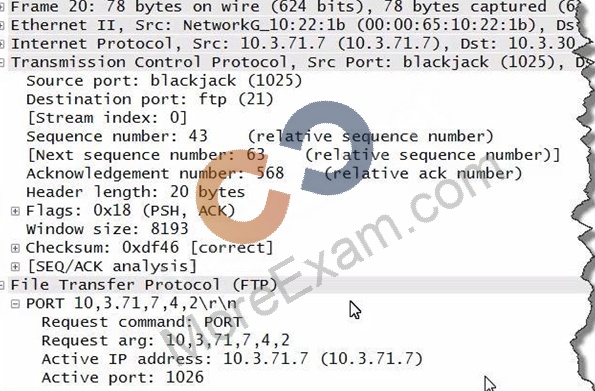
Which statement about this packet is correct?
Question22: What is the most efficient method for saving non-contiguous packets in a trace file?
Question24: Which statement about TCP sequence and acknowledgment numbering is correct?
Question25: With a few exceptions, display filters use the same syntax as capture filters.
Question26: 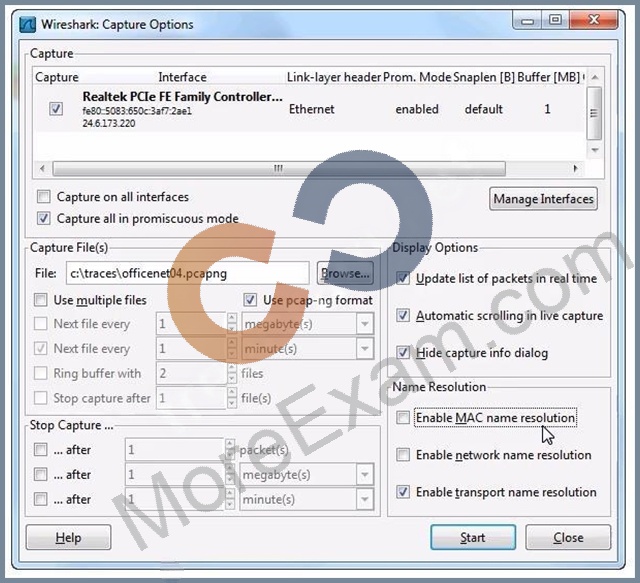
Which statement about the Capture Options window shown is correct?
Question27: Which term defines an alias name used in DNS responses?
Question28: 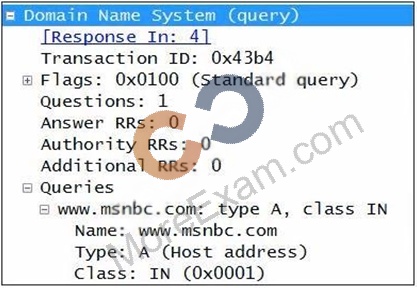
This is a DNS inverse query packet used to resolve an IP address to a host name.
Question31: 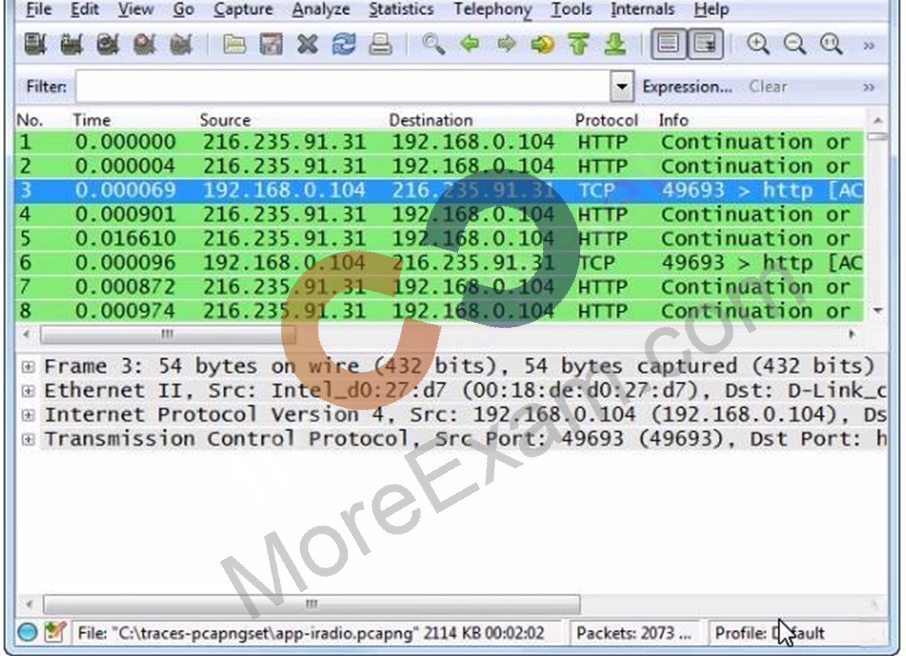
Which statement about this Wireshark image is correct?